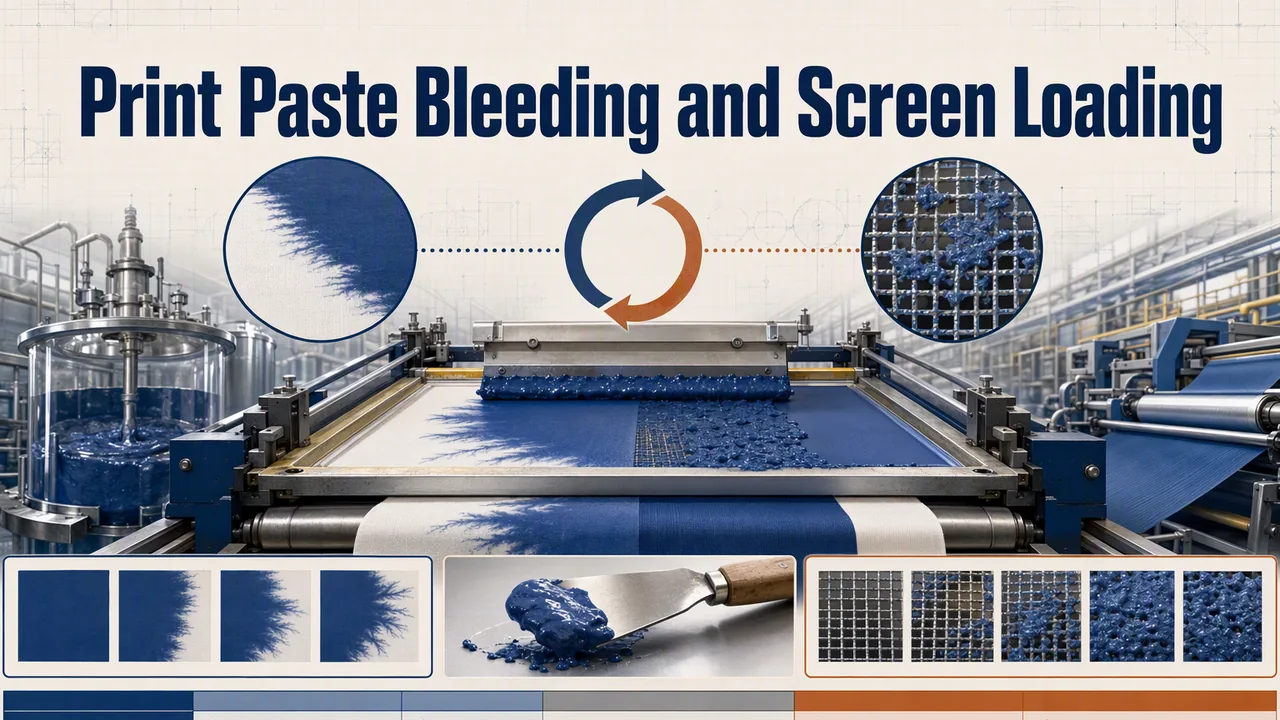
The shop runs six-color water-based pigment printing on cotton knit, and the third color kept losing its edges. By the second pallet the operator had dropped the paste viscosity twice to clear the mesh, the outlines had gone soft on the next pass, and someone was blaming the pigment mill. We have watched this loop burn a production week before: bleeding and screen loading are not two problems. They are one rheology window being missed from two sides.
Two Failures That Feed Each Other
On the press, the squeegee pushes paste through an open mesh onto fabric. The instant the blade passes, the paste has to rebuild structure fast enough that capillary action in the yarn does not pull it outward. If the low-shear viscosity after the shear spike is too weak, the dot edges walk. That is bleeding.
Screen loading is the other side. Paste that dries on the mesh between strokes, or pigment agglomerates larger than the mesh opening, or a thickener that films over, gradually blocks the same openings you need open. The operator reaction, thinning with water, clears the mesh today and guarantees bleeding tomorrow, because it lowers the exact property that holds the edge.
One more mechanism worth naming: waterborne paste is water-carried. The fabric absorbs the water front unevenly, faster along slubs and sizing gaps, and the pigment rides that front. A paste that fights bleeding on a calm day can feather badly in a humid hall, because the fabric surface is already wet when the paste lands.
Diagnose With a Spatula, Not a Slogan
Before touching the formula, run four checks that take an hour. Draw down a stripe of the running paste on the actual goods and watch it for sixty seconds under a lamp; the bleeding you fear is visible there, not only after curing. Measure the paste at two shear rates rather than one Brookfield number, because a single reading hides the recovery behavior that matters; the ASTM D2196 rotational viscometer methods cover the procedure, and a shear-stress sweep tells you the recovery in one curve. Check the pigment grind on a Hegman gauge against your mesh opening; anything close to a third of the mesh width will load the screen. And weigh the mesh before and after an hour of printing to see how much dry film you are actually parking on it.
The Failure Table
| Symptom | Likely cause | First move |
|---|---|---|
| Edges feather right after squeegee | Weak structure rebuild; paste too thin | Raise low-shear recovery, do not add water |
| Mesh clogs after minutes of idling | Skim skin forming on the screen | Shorter idle exposure; check thickener film-forming |
| Clogging only in dry hot shifts | Drying at the mesh faster than ink supply | Hall humidity and squeegee speed, not resin |
| Pinholes in heavy coverage | Air in paste, or grind too coarse for mesh | De-gas overnight; verify Hegman reading |
| Print sharp, washes soft after cure | Flash-off drives pigment into the water front | Lower initial flash, step cure after fixation |
| Rough hand and dull color | Too much extender, binder starved | Rebalance solids, see binder window below |
Build the Paste Around the Binder Window
Once the press-side moves are done, the paste itself has two knobs: how much water it carries and how its binder behaves under the blade. A low-viscosity binder lets you load pigment without loading water. Our YT-8081 printing-paste grade runs at 35 ± 2% solids while staying at 50–200 mPa·s out of the drum, so the paste thickness comes from structure, not from diluting the binder; the film takes 600% elongation, which keeps hand soft on stretch knit. When a design needs body, high-solids is the honest route: YT-1155 arrives at 55 ± 2% solids with elongation above 1,300% and viscosity of 200–1,200 mPa·s, built for thick-hand and plate pastes where every gram of water you skip is a gram of bleeding you do not have to fight. The YT-8081 TDS and the YT-1155 sheet carry the film tables. Both grades sit in our waterborne polyurethane binder line, and the same family does the wet-rub work we covered in the wet rubfastness note, so sharpness and wash fastness are not traded against each other here.
Rheology Is Where the Fix Usually Lives
The thickener choice decides whether you have a window at all. Associative polyurethane thickeners build structure that collapses under the squeegee and rebuilds the moment shear stops, which is exactly the shape textile paste needs. Our YT-255A is a nonionic HEUR dosed at 0.5–2.0% of the formula, pH-independent, and strong at low shear with pseudoplastic flow; the rheology additive page lists the rest of the grades for blending a curve. Cellulosic thickeners tell a different story: they hold water, they bleed on humid days, and some of them film over the mesh, which is the loading complaint in a different costume. We keep cellulose out of fine-line work and only mix traces of it when a shop needs cheap body on a coarse design.
And the honest limit: past roughly 1.5% HEUR the curve overshoots, the paste strings between the mesh and the garment, and edges start looking saw-toothed under magnification even though the gross outline is sharp. If you are dosing above that to hold an edge, the problem is water load, not thickener load. Go back to the binder.
Screen Printing Paste FAQ
What mesh count for water-based pigment paste?
For line work and halftones on knit we start at 120 to 156 threads per centimeter and step down for heavy coverage. Fine mesh sharpens edges but narrows your tolerance for grind coarseness, so pair any count bump with a Hegman check first.
Can I just add water when the screen loads?
You can, once, and only as a mesh wash between runs. Water inside the paste is how a bleeding complaint gets written the following morning. Clear the screen, check the idle time and humidity, and keep the paste formula untouched.
Why does the same paste behave differently in the rainy season?
Because the water front in the fabric changes with hall humidity. High humidity slows flash-off and extends the time pigment can travel, and cotton sizing that dries crisp in October stays damp in March. Adjust the flash profile seasonally; we keep separate cure curves for our summer and monsoon trials.
If your outlines are drifting batch to batch, send a wet drawdown on your own goods plus your mesh spec to our application lab. We will run it on both press speeds and hand back a paste curve, not a slogan.