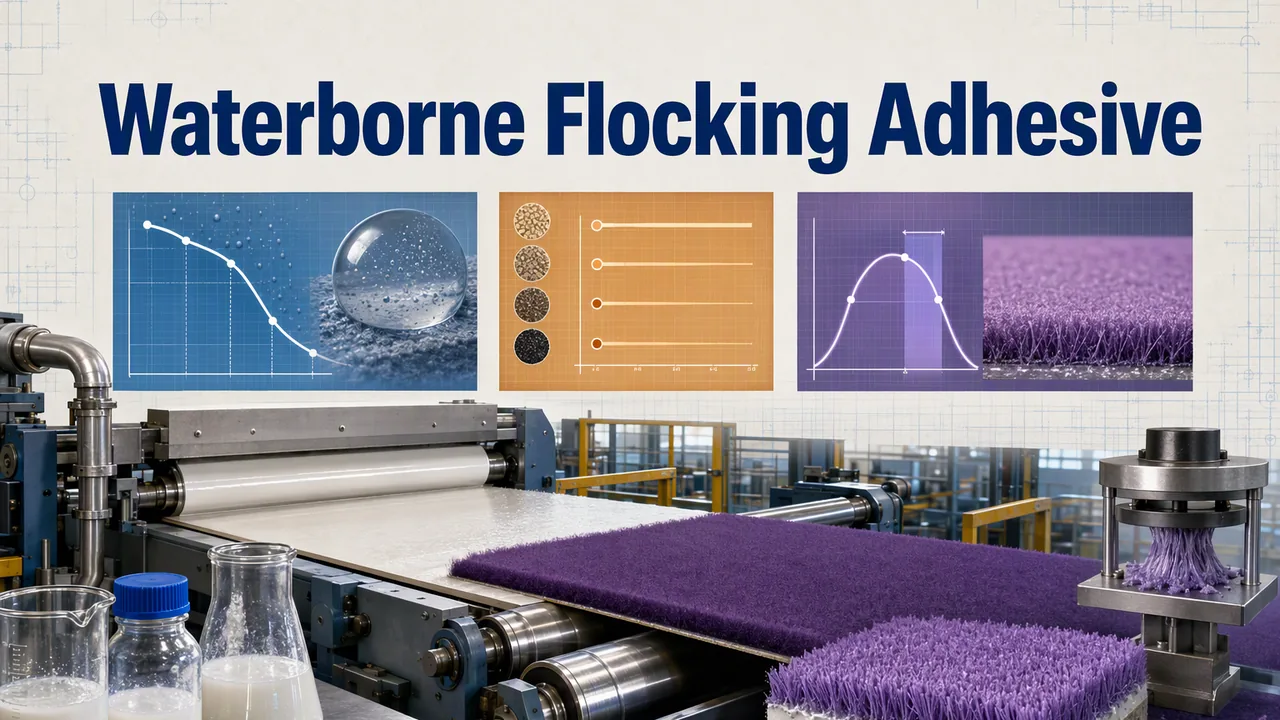
The first flocking line we converted ran a PVC organosol in a plant outside Guangzhou. The operator had one habit that told me everything about the difference between the two chemistries. After the adhesive head passed, he would walk the length of the line and check the count sheet at the far end, and only then drop the pile. Solvent gave him eight minutes of open film. Waterborne gave him something closer to ninety seconds, and he spent a week of rejected rolls finding out where the missing minutes had gone.
Almost every flocking defect I am sent is an argument with that single fact, not a complaint about an adhesive.
Why the Waterborne Window Closes So Fast
A solvent flocking adhesive keeps its resin dissolved, so the pile can land into a film that is still liquid minutes later. That layer is also thick, which lets it grip the fiber root mechanically. Waterborne polyurethane arrives as particles carried in water. The film only exists once those particles coalesce, and coalescence is a one-way process that starts the moment water leaves the surface.
Surface tack is the visible half of that curve. YT-200 is an anionic aliphatic dispersion at 45 ± 1% solids and pH 6–8. It keeps a wet, grabby surface longer than most binders in its corner of the waterborne PU range. Longer is not forever. Once the particles touch and fuse, the pile lands on a skin. The root sits on top of the film instead of inside it. The panel looks correct on the table, then fails on the first brush rub at the customer's.
Two decisions follow from that, and they are the whole conversion. You choose where in the viscosity band the adhesive should sit. Then you find the seconds between wet enough to grab and closed enough to hold.
Picking the Grade for the Way You Flock
The published viscosity band on YT-200 is wide on purpose, 100 to 1,000 mPa·s, because a screen head and a dip tank want opposite things. Tell us which end your equipment needs before a drum is packed, rather than trying to tune a 125 kg batch on the line with water.
| Flocking method | What the film has to do | Where we start |
|---|---|---|
| Screen or roller flocking on paper and film | Stay thin and sharp, and not strike through the sheet | Thin end of the band, one pass, pile dropped as soon as the head clears |
| Dip and spray coating on elastic goods | Stretch with the substrate and recover without popping pile | As supplied: 45 ± 1% solids gives the soft, extensible continuous film this job needs |
| Automotive and waterborne leather flocking | Hold solvent and heat resistance, and stay pale | Aliphatic backbone as the baseline, then a crosslinker for the solvent spec |
| Short pile on open-weave fabric | Get adhesive to the root without closing the weave | Two thinner passes with flash-off between, never one heavy pass |
Being blunt about the limits: a waterborne adhesive will not build the same cushion thickness in one pass that a plastisol does. Velvet-type pile with that deep, padded hand is the one place the solvent route still wins on cost per meter. There you buy the thickness with the adhesive itself, not with a second drying zone.
Finding the Tack Window on Your Own Line
We stop guessing this number and measure it. Run one long panel, drop the pile in bands at twenty-second intervals after the head passes, then brush-rub each band and count until the pile lifts. The result is a strip of visible pass and fail on one panel, and it takes an afternoon. Everything else on the line is then set around that window rather than around the old solvent timings.
Three variables move it, in this order of how much they cost to fix. Flash-off air and dryer setpoint decide when the film closes. Humidity decides whether the water leaves at all; above roughly 75% relative humidity the window widens, which sounds like a favor and is really a soft-film problem. Add-on weight decides how much mobile resin is left at the root when the pile arrives.
| Symptom on the roll | What the film was doing | First move |
|---|---|---|
| Pile pulls out under a brush or tape, coverage looks fine | Pile dropped after the skin formed, so the root never entered the film | Shorten the drop distance or slow the head, then re-run the twenty-second ladder test |
| Edges of the pattern go fuzzy and the design loses definition | Pile dropped into a film still too wet to hold position, so the fibers walked | Add flash-off time before the flock head, one notch at a time |
| Bald patches in the middle of a wide panel | Adhesive skinning at the edges first, or an uneven head gap across the width | Profile the head at three points and check the duct flow over the middle of the table |
| Hand feels boardy, and the coating cracks on flexing | Add-on riding too high, or a crosslinker overdose stiffening the film | Drop the pick-up weight before touching the crosslinker level |
| Pile releases solvent or water stain marks after a wet wipe | Film coalesced but never fully cured, so the binder is still water-sensitive | Measure film temperature, not oven air, and extend time at temperature |
| Viscosity climbs in the trough during the shift | Water leaving the open bath, plus an anionic system meeting a cationic softener residue | Keep the trough covered, dose fresh, and never trust the previous batch's softener |
Opening the Window With Chemistry
When the mechanical fixes are exhausted, the window itself can be widened. This is where the two crosslinkers we keep on the shelf differ in a way that matters on a flocking line.
YT-G30 is a polymeric carbodiimide. It reacts with the carboxyl groups in the resin, slowly at room temperature and quickly as the film dries and warms. That profile is close to ideal here. The trough stays open through the shift, and the bond forms when the part enters the dryer rather than while it sits in the head. It also improves hydrolysis resistance and does not need the aziridine handling argument, since it is positioned as a non-sensitizing replacement for those grades.
YT-6300 is a waterborne anionic curing agent made from aliphatic monomers, at 20.5 to 21.5% NCO, which mixes into the resin by hand stirring. Its published open time is three to four hours, so it buys hardness, water and chemical resistance on a shift-length clock instead of a trough-length one. The high NCO content means the dosage is lower than with conventional grades, and the anti-yellowing matters on pale pile. Both are documented in the YT-G30 and YT-6300 TDS sheets.
What a crosslinker does not do. It will not give you the thick mechanical grip an organosol layer gives, and it cannot rescue pile that landed on a closed skin. Overdose it and you get the opposite problem, a film that skins sooner and a hand that stiffens. We would rather see the ladder test run first.
What We Test Before a Line Believes It
- The twenty-second ladder panel, because every other number is meaningless if the drop timing is wrong.
- Pile retention by stiff-brush count on the pass band, read before and after conditioning rather than only fresh off the dryer.
- Dry and wet crock per ISO 105-X12, since a flock that passes coverage and fails crocking is the classic converted-line complaint.
- Five washes at 40 °C, then the brush count again. This is where an under-cured film shows up, and it is the same argument we make on wash and dry-clean durability.
- Hand and gloss judged against the solvent panel the customer is holding, plus a flex check on anything destined for an elastic substrate.
- Storage sense: YT-200 is kept at 5–30 °C for twelve months and must not freeze, so a winter container or a summer yard needs a plan before the first order, not after the drum arrives cold.
Ask for the YT-200 TDS and send us two failed panels plus your pile length and head speed. We will run the ladder test on your fabric and put the waterborne window next to your solvent timings, in writing.
Questions From the Flocking Trial
How much line speed do I actually lose on a waterborne adhesive?
The adhesive itself is not the constraint; the flash-off is. On a short machine where the flock head sits close behind the applicator, you recover the window by slowing the belt, and that is the honest cost. On a line with an existing drying zone you can often hold speed, because the water leaves during the distance you were already paying for.
Can I keep my current softener and pigment additives?
Not automatically. YT-200 is anionic at pH 6–8, so a cationic softener will break it in the trough and you will read that as a viscosity problem. Run one beaker test before one drum. Non-ionic additives are the safe starting point, and a pigment paste should be checked for the same charge question.
Which do I reach for first, the carbodiimide or the isocyanate curing agent?
If your complaint is open time in the trough, start with YT-G30, because its room-temperature reaction is deliberately slow. If your complaint is the wash or solvent spec after the pile is holding, start with YT-6300 and work inside its three to four hour clock.
Send your fabric, your pile, and the panel you rejected this week: ask our application lab.