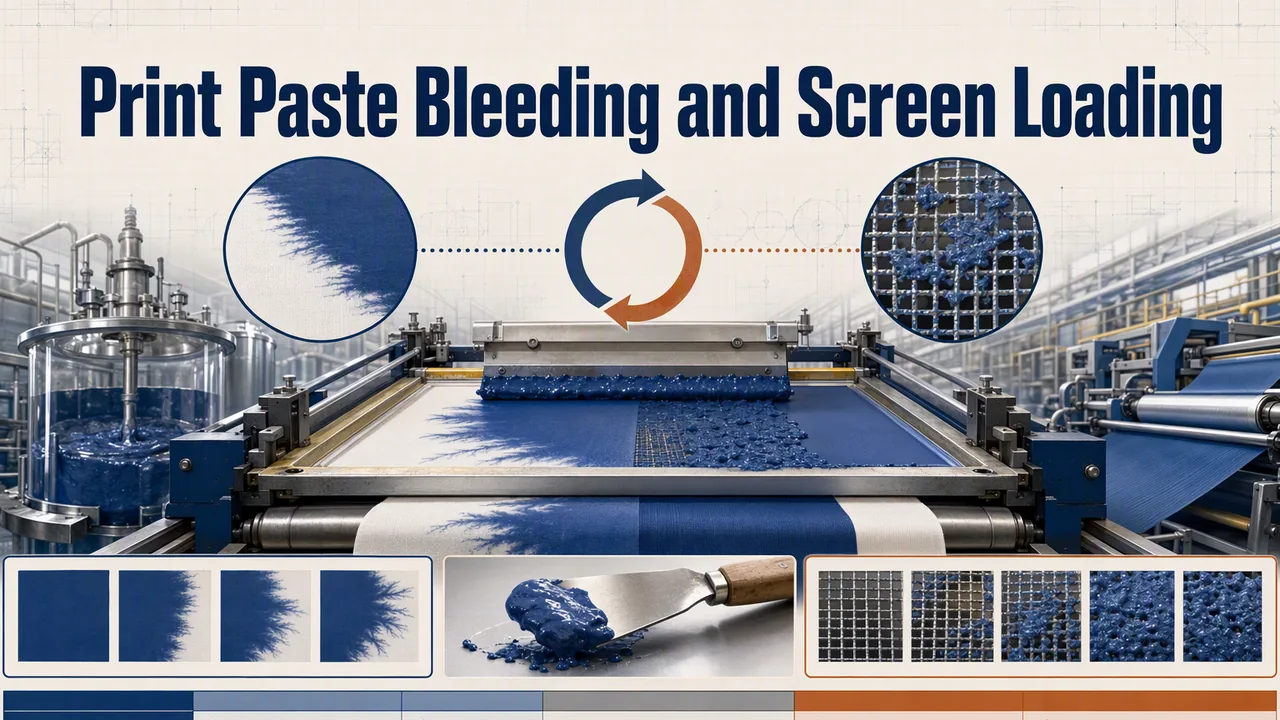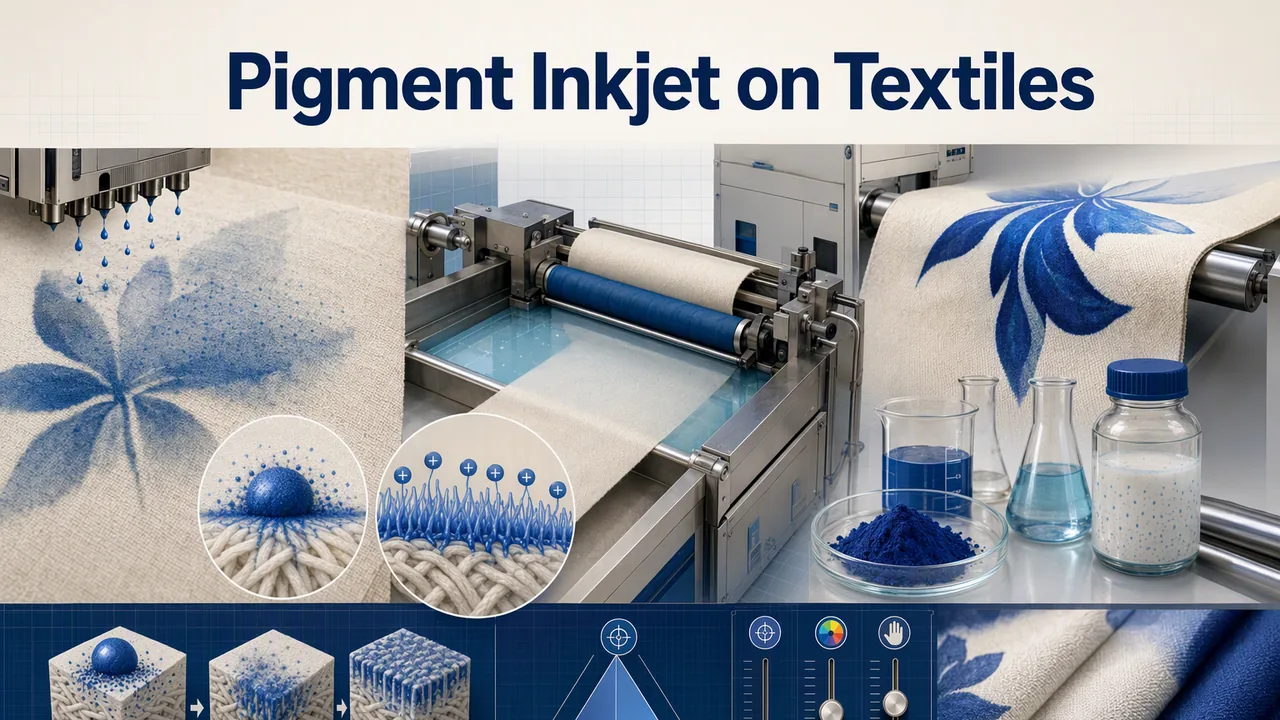
A 0.4 mm halftone dot lands on scoured cotton and turns into a 0.9 mm blur before the dryer reaches it. The print room calls it feathering, the mill calls it a rejected sample, and in almost every line we have debugged it is the same cause: a waterborne pigment drop sits in a wet ring long enough for capillary action to carry it sideways through the yarn, and nothing in the process stops it. Reactive ink carries the same water. It just bonds to the fiber instead of waiting. Pigment bonds to nothing on its own, so fixation becomes your problem to solve before the ink ever reaches the printer.
Why Pigment Behaves Differently on Cotton
Cotton and viscose take a slight negative surface charge when wet, and most waterborne pigment inks are anionic dispersions kept apart by that same charge. The particle has no reason to settle down where the nozzle aimed. It stays suspended in the water front, and the fiber network happily wicks that front millimeters outward, depositing a faint halo around what used to be a crisp edge. Color yield falls with it, because pigment that should sit on the surface is now smeared through the upper yarn structure and diluted at the viewing plane.
Reactive and acid inks dodge this through chemistry: covalent or ionic bonds to the fiber. They pay for it with steaming, wash-off, and a narrower practical gamut than pigment offers. The appeal of digital pigment is exactly the opposite trade: no wash-off, bright whites, one machine for cotton and blends. The one thing you cannot skip is something in the fabric that catches the particle before the water moves.
The Cationic Pad, Step by Step
That something is a sacrificial opposite charge. Pad a dilute film of YT-7010, a waterborne polyurethane dispersion with real cationic character, onto the goods, dry it, then print pigment inkjet straight onto the treated face. When the anionic drop hits the dried cationic film, the charge balance collapses at the interface and the dispersion coagulates within the drop footprint, essentially on impact. Lateral wicking gets no pigment-carrying front to work with, so the outline stays where the RIP put it.
The working numbers on our material are narrow and specific. Dilute 1:19 with water and treat that as the starting point, not the law. Pad to a wet pick-up of 65–75%, then dry at 100–105 °C for roughly three minutes; the YT-7010 TDS flags that drying above 110 °C can cost you wash fastness, and we have believed that lesson since a trial batch baked hot gave wet crock grades two full steps lower on the same recipe. After printing, cure at 150 °C for three minutes so the pigment's own binder coalesces and the pad film ties in alongside it.
Two spec points matter on light grounds. The dispersion runs 16 ± 1% solids at pH 4–7, so the pad is a thin, nearly invisible film rather than a coating, and it dries colorless and transparent: white stays white with no tint cast. It is aliphatic, so pale goods on a warehouse shelf do not creep yellow the way an aromatic pad film would. The lane we sell it for is light-colored cotton and polyester-cotton, and we say that openly because a dark ground changes the value equation, as below.
Dialing Sharpness Against Color Yield and Hand
Once the chemistry is agreed, the process is a set of three knobs: dilution, pick-up, and heat. Every fabric we have pretreated lands somewhere in the same failure table, so work through it from the symptom side rather than from the recipe side.
| Symptom at the delivery pallet | What the pad is telling you | First move |
|---|---|---|
| Edges feather, color looks washed out | Cationic add-on too low: over-diluted bath or squeeze roller pressure down | Return toward 1:19, verify 65–75% wet pick-up at the nip |
| Pale ring around dense solids, ink re-wets badly | Pad dried above 110 °C and the film collapsed into a non-reactive skin | Drop dryer set to 100–105 °C and re-test before resuming the roll |
| Dry crock passes, wet crock sits at grade 2–3 | Under-cure: the fabric never actually saw 150 °C for three minutes | Measure fabric temperature, not oven air; slow the tunnel or shorten the load |
| Hand feels stiff, slightly papery | Pick-up riding the top of the window, binder film bridging yarns | Run pick-up at 65–68% and re-judge drape after cure |
| Sharpness drifts meter to meter across one roll | Pad bath depleting or nip pressure uneven across the width | Drip-feed the trough to constant volume; profile squeeze pressure at three points |
Read the table as priorities, not a menu. Fix the dry temperature before you touch dilution, because a collapsed film punishes you on wash fastness long after it stopped punishing you on sharpness. And know what the pad costs you: a mangle and a dryer ahead of the printer, a bath to keep dosed, and a slightly fuller hand at high pick-up. It also buys you nothing on a black tee, where the white underbase does all the sharpness work and a pretreatment layer is pure added cost. If your shop runs YT-7011 cationic pigment ink instead, the fixation already lives in the ink and you should skip the pad entirely.
Test the Pad Before the Line Believes It
We will not sign off a pretreatment from a single dry print. Print a test card carrying 0.2 mm lines, 60 and 120 dpi halftones, and solid navy and black patches, then run three checks. Loupe the lines for feather width, that is the sharpness claim in microns. Read color strength as K/S on the spectrophotometer before and after laundering, because yield is where halo damage hides. Then rub: dry and wet crock per ISO 105-X12, and wash the card per ISO 105-C06 before the wet rub, not after a hoped-for grade. Our acceptance pattern on light cotton is dry crock at grade 4–5, wet at 3–4, and under half a percent K/S loss at five 40 °C washes.
Wet rubbing on pigment prints has its own failure anatomy, mostly binder-versus-diffusion arguments that a pretreatment does not settle alone; the wet rubfastness note covers that side, and the pad mechanics above apply to the same fabric family at the textile coating end of it.
Questions from the Print Room Floor
Can a cationic PUD pad replace the classic alginate plus fixative pre-treatment?
For roll-to-roll pigment printing, yes, and most lines prefer it. Alginate brings viscosity drift, nozzle-adjacent crust and salt marks; a dried PUD film leaves none of those behind. The catch is equipment: a padding mangle is a different footprint from the spray or roller applicator flatbed shops usually own, so sampling on a hand pad and full padding on a line are genuinely different tests.
Why does the product scope stop at light-colored cotton and blends?
Not because the chemistry fails on dark goods. Because the economics do. On white and pale grounds the pad is what makes sharp outlines and full yield possible at all, and customers can see it in the quote. On dark grounds you are paying for an underbase first, and the pad's sharpness benefit mostly washes out under that white layer.
What changes when I move from 100% cotton to polyester-cotton?
Keep the pad at the same dilution and pick-up; the cotton phase still wicks and still needs the charge trap. Expect the cure window to matter more on the blend, since wash fastness leans harder on binder coalescence when fewer fibers actually soak. Do not raise the cure temperature past 150–160 °C to chase that; extend time at temperature instead.
Send a piece of your greige and a failed print, and we will run the pad-dry-cure-crock cycle on it and put the numbers next to your current process: ask our application lab.